Three coins · Sixty-four hexagrams · A living book
Ask a question.
Cast a change.
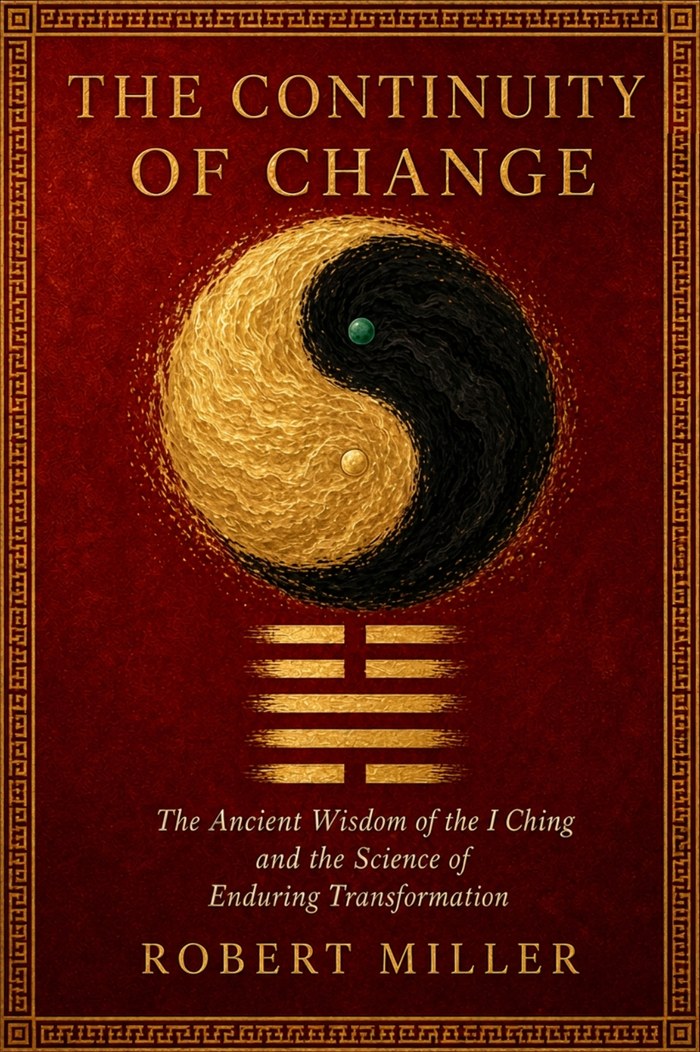
A companion to Robert Miller’s The Continuity of Change: the ancient wisdom of the I Ching and the science of enduring transformation.
The coins are ready.
The sixty-four figures
Hexagram library
Browse every hexagram by King Wen number. Judgment, Image, and line texts are from James Legge’s public-domain translation of 1882.
On this device
Reading history
Saved only in your browser’s local storage. Clear it anytime. Sharing a reading copies a link with the hexagram values, not a server record.
About this companion
The Continuity of Change
This app is a working I Ching companion from International Publishing Corporation, tied to Robert Miller’s book The Continuity of Change: The Ancient Wisdom of the I Ching and the Science of Enduring Transformation — IPC’s first book, a standalone precursor to the 21-volume China Series.
Cast a question by the traditional three-coin method. Each hexagram is given with its Chinese name, Legge’s public-domain Judgment, Image, and line texts, and a short modern “continuity of change” reflection written for this app. Where lines change, you will also see the relating hexagram — the figure the situation is moving toward.
Reflections in this app are original companion notes. They are not presented as quotations from the book, except for the clearly marked excerpts from Chapter One on hexagram 32, Heng / Duration, which is the chapter’s emblem: what lasts is not what never moves, but what keeps its direction while moving.
The three-coin method
- Hold your question clearly. Six times, throw three coins.
- Heads (yang) count as 3; tails (yin) count as 2.
- 6 (three tails) is old yin, a changing broken line. 7 (two tails, one head) is young yang, a stable solid line. 8 (two heads, one tail) is young yin, a stable broken line. 9 (three heads) is old yang, a changing solid line.
- Build the hexagram from the bottom line to the top. Changing lines produce a second, relating hexagram.
Sources
Hexagram texts are from James Legge, The Yî King, The Sacred Books of the East, Vol. XVI (Oxford: Clarendon Press, 1882), which is in the public domain. Chinese characters, pinyin, trigrams, and King Wen order follow standard reference data. Short English names such as “Duration” are conventional labels; Legge’s own titles (for example, “Hăng”) appear with each figure.
Robert Miller is President of International Publishing Corporation. He has spent more than fifty years studying and teaching the traditions of Asia, and he brings that work to this book and to the China Series launching January 15, 2027.